
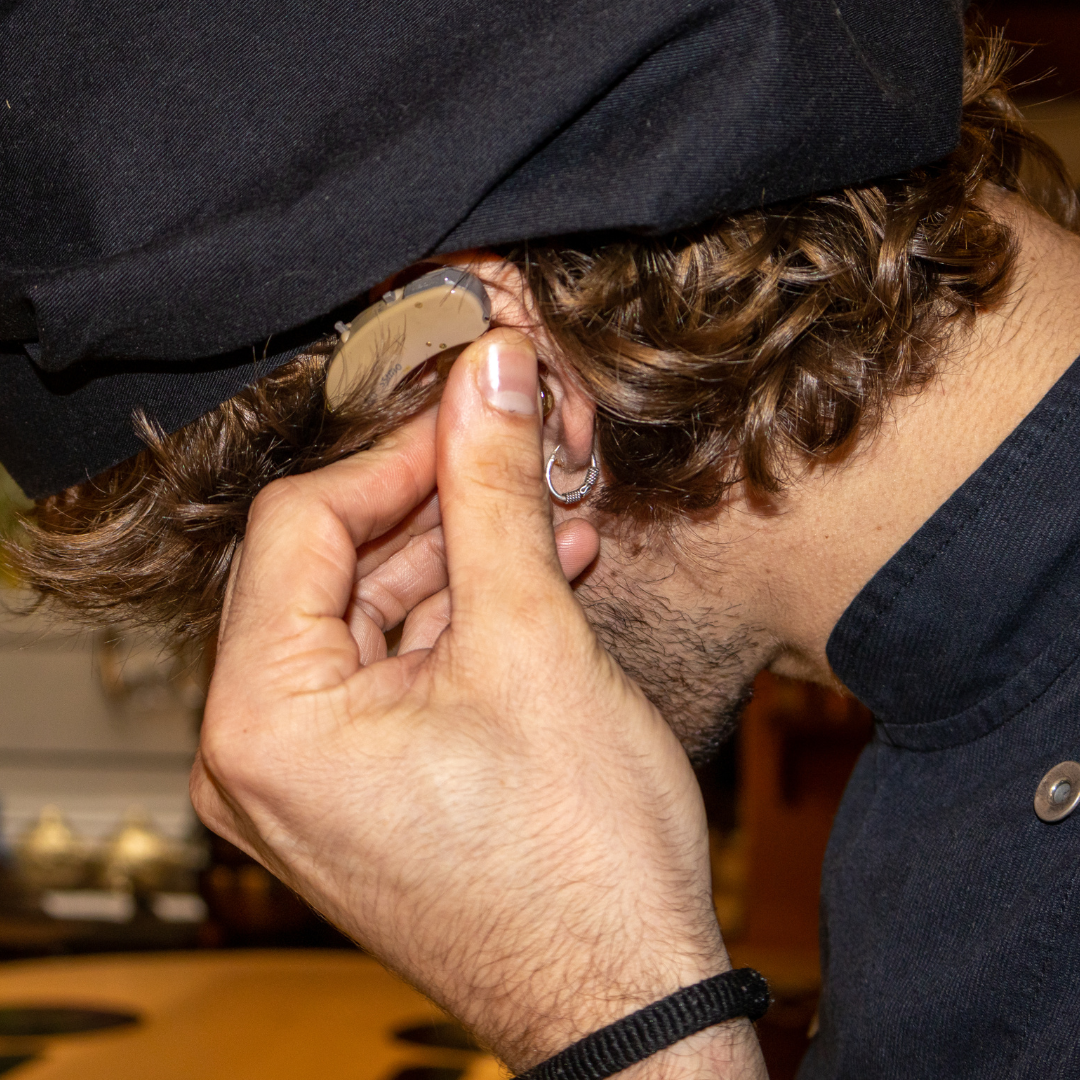
Group discussions in restaurants often become difficult to comprehend when room acoustics compete with your focus and hearing. Our practice provides targeted diagnostics to evaluate hearing in quiet atmospheres as well as complex noise environments. Once the diagnostic etiology of your difficult hearing is established, we implement personalized clinical and technological strategies.
Why Can I Hear Normally but Struggle to Listen in a Restaurant?
Calm domestic settings establish a positive signal-to-noise ratio, allowing target speech to stand out clearly from faint background noises. Restaurants create the opposite situation. Cross-talk, ambient music, dishware noise, and harsh acoustic reverberation interfere with speech clarity, forcing your brain to labor to extract the target voice.
This symptom pattern often reflects underlying high-frequency hearing loss, central processing dysfunction, or physiological aging of the auditory nerve. Attention, fatigue, dim lighting, and distance from the speaker may make it worse. Some patients pass standard pure-tone evaluations with normal scores yet exhibit substantial impairment during specialized speech-in-noise testing. Difficulty in restaurants deserves evaluation even when everyday hearing seems normal.
How Audiologists Identify High-Frequency Hearing Loss
We begin with a history of the situations that cause trouble, along with questions about noise exposure, tinnitus, medications, family history, and changes in either ear.
Standard pure-tone audiometry gauges the lowest volume thresholds detectable across varying acoustic frequencies via specialized earphones and bone oscillators. A clinical presentation of high-frequency loss produces a downward-sloping audiogram where auditory thresholds worsen significantly at higher frequencies. Additional testing may include tympanometry to assess middle-ear function and word-recognition testing to measure speech understanding.
Standard quiet test booths fail to simulate real-world restaurant noise, making speech-in-noise testing a crucial clinical tool. It evaluates sentence-level speech comprehension as competing background babble increases in volume. Combined, these clinical findings determine whether your symptoms stem from acoustic audibility, word clarity, central noise filtering, or multifactorial causes.
Understanding Auditory Processing Disorders in Noisy Environments
An auditory processing disorder affects how the central auditory nervous system interprets sound. Even when the ears detect individual frequencies accurately, the central auditory system may falter at sorting overlapping voices, distinguishing close speech sounds, or processing fast-paced dialogue. We systematically verify peripheral hearing health before establishing whether an advanced auditory-processing evaluation or medical referral serves your needs.
Behavioral Strategies for Hearing Clearly in Loud Venues
Targeted behavioral changes optimize the acoustic speech signal reaching your auditory system while providing clear visual context. When planning to dine out, select restaurants with calmer atmospheres or arrange reservations during off-peak hours. Facilities equipped with upholstered booths, acoustic baffles, fabric curtains, carpeted floors, and soft materials prove far easier on hearing than minimalist, hard-tiled spaces.
Practical seating strategies in the dining room:
- Ask for seating positioned far away from open kitchens, noisy bar areas, ceiling speakers, and large parties.
- Position yourself with your back toward a solid partition to dampen intrusive background noise from behind.
- Face your conversation partners in good lighting.
- Maintain the shortest comfortable physical distance between yourself and your conversation partner.
- Orient your stronger ear toward the key person you want to follow in conversation.
- Prompt companions to rephrase unclear sentences with alternate terminology instead of repeating identical words.
- Actively confirm key information rather than smiling and guessing at ambiguous dialogue.
- Excuse yourself for a momentary quiet pause when listening exhaustion starts to mount.
- Ask dinner guests to speak with clear enunciation at a steady, natural conversational rate.
- Elevated yelling distorts auditory signals and seldom improves actual phonetic comprehension.
Modern Audiological Tools for Managing Background Noise
Selecting the ideal assistive technology depends upon underlying diagnosis, specific acoustic challenges, and verified hearing loss. Professionally fitted hearing aids may use directional microphones, digital noise reduction, and dedicated restaurant programs to emphasize speech from the front and reduce some competing sound. However, users must maintain realistic expectations, as no clinical technology can eliminate every competing background speaker entirely.
Incorporating a dedicated remote microphone provides an even more pronounced improvement in signal-to-noise ratio. The accessory is worn on the lapel or set near the speaker, streaming their voice directly into compatible hearing aids or wireless audio receivers. This reduces the effects of distance and surrounding noise.
Supplementary auditory solutions include:
- Omnidirectional table microphones designed for group dining tables
- Telecoil sensors configured to access hearing-loop broadcasts in looped facilities
- Smartphone speech-to-text or live-captioning applications
- Advanced hearables incorporating assistive directional listening programs
- Decibel-level applications and restaurant rating guides for finding quiet tables
We analyze suitable devices, verify functional compatibility with your current setup, and guide you through real-world operation.
How Can a Doctor Help with Hearing in Loud Places?
A comprehensive hearing evaluation looks far beyond the common misconception of “I hear fine in quiet environments.” We assess the specific acoustic settings, speaker dynamics, and volume levels that disrupt your hearing to administer targeted evaluations. Your diagnostic appointment may incorporate pure-tone air and bone thresholds, acoustic middle-ear testing, word-recognition scores, and speech-in-noise measures. Central auditory-processing testing is considered whenever clinical intake and initial test outcomes point toward higher-order deficits.
Sudden, one-sided, or rapidly worsening symptoms may require medical evaluation by an ear, nose, and throat physician. Personalized care identifies the source of the difficulty rather than assuming restaurant noise is the only problem.
Schedule a Diagnostic Hearing Evaluation Right Away
If noisy restaurant gatherings leave you struggling to follow dialogue, pulling away, or feeling completely drained, schedule an audiological evaluation with our team. We will help you navigate hearing in noisy environments by implementing advanced hearing aid options, assistive accessories, or therapeutic auditory strategies tailored to your lifestyle.
Contact our practice today to book your consultation and take a decisive step toward reconnecting in social settings.